


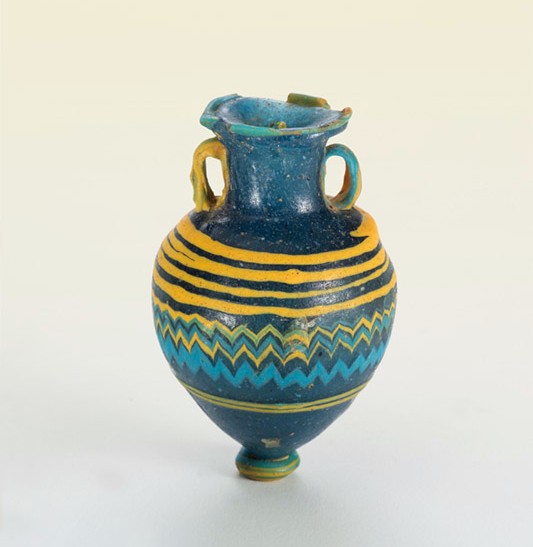
Amphoriskos, Glass, core-formed, Persian period , 6th-5 th centuries BCE, Glassware in Antiquity
Photographs: Studio Warhaftig Venezian Ltd.
Glassware in Antiquity
The secret of glassmaking was already known in the ancient world: take sand that is rich in silica, quartz, and potassium salts, heat it gradually to 1100 Celsius, and you will get an almost liquid, mailable material. Once the liquid has cooled down and solidified, you will have lumps of raw glass that can be remelted and fashioned into vessels and jewelry.
This important technological knowledge was attained over time and preserved in ancient records. The earliest documentation of formulae and instructions for the production of glass were found on a cuneiform tablet discovered near Tell Umar by the Tigris River, dated to the 14th or 13th centuries BCE. Cuneiform tablets of the 7th century BCE, discovered in Nineveh in the Royal Library of Ashurbanipal, the Assyrian king, include glassmaking instructions: how to build a kiln, the types of firewood that should be used, formulae for the right quantities for different vessels and colors, and the order in which they should be mixed.
Evidence of the production of glass, including beads and raw glass, was found in Mesopotamia as early as the end of the 3rd millennium BCE. However, the first glass vessels appeared in Mesopotamia only from the middle of the 2nd millennium BCE. From there, the industry soon spread to Egypt. Due to the complexity of the glass production process, for thousands of years glassware was only used by the ruling and noble classes.
The ancient glassware in this display was made using the two most familiar methods: The earlier core-forming technique, and the blowing technique developed during the Roman period, which made glass accessible to the general populace.